
August 3, 2026, 09:00
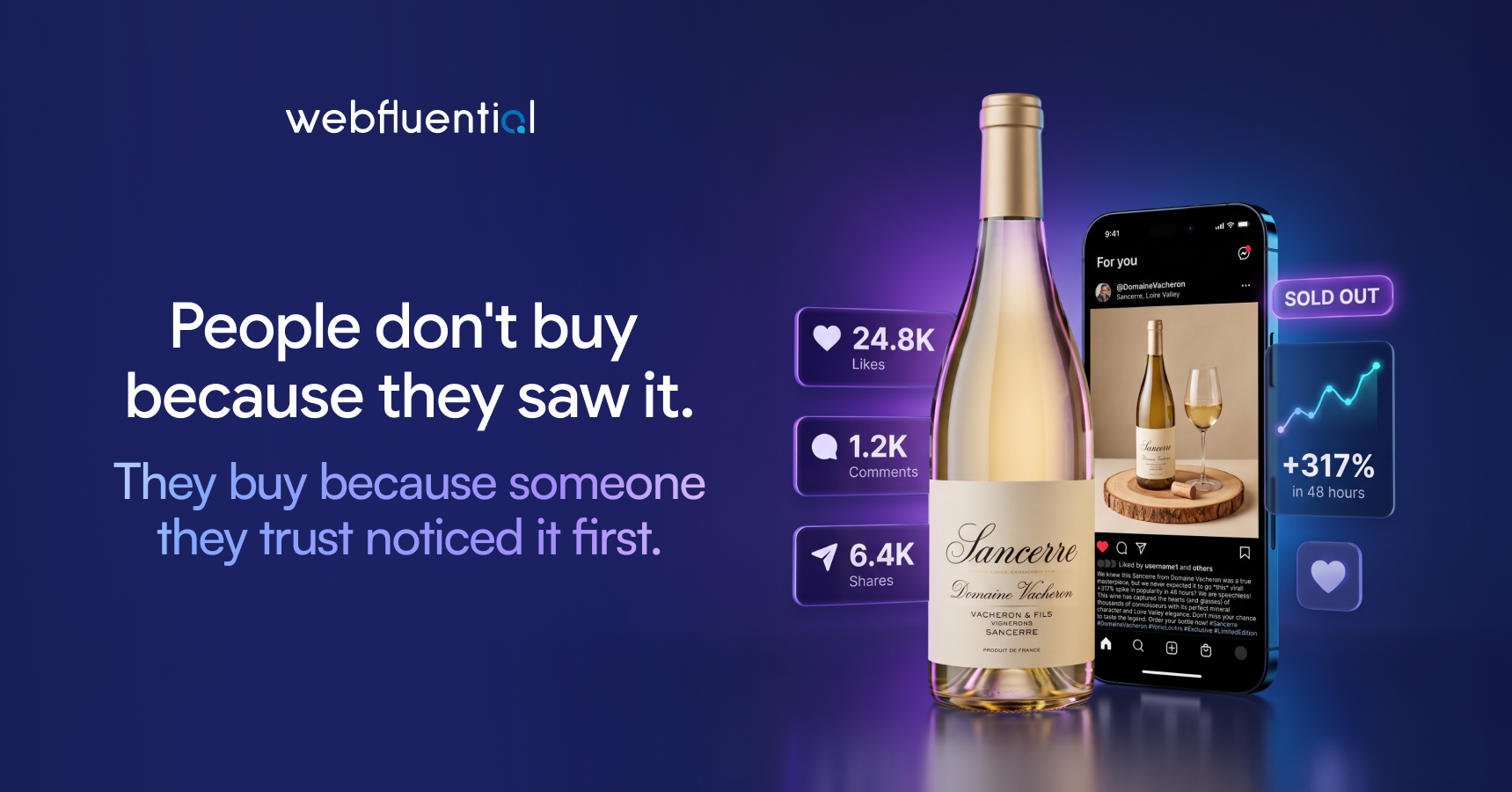
What a sold-out bottle of Sancerre reveals about Creator-led demand

Justine Wheeler
 Add Webfluential as a preferred source
A fleeting appearance in Taylor Swift’s docuseries was enough to sell out a French wine online. For businesses, the real lesson is not celebrity endorsement. It is how attention, cultural relevance and community trust can translate into commercial demand.
A bottle of wine appeared briefly beside a mixing desk during episode five of Taylor Swift’s The End of an Era docuseries.
There was no product demonstration. No discount code. No carefully scripted endorsement.
Yet fans identified the bottle as a Sancerre produced by Domaine de Terres Blanches, shared the discovery online and reportedly caused stock to sell out on the website of its US distributor. The wine retailed for approximately $40 in the United States.
The incident quickly became another example of “Swiftonomics”, the term used to describe the commercial impact generated by Taylor Swift’s cultural influence.
But this is not only a story about one celebrity or one bottle of wine.
It is a lesson in influencer economics: how attention, trust, context and community participation can create measurable economic value for a business.
Influence can create demand before advertising begins
Traditional advertising operates through deliberate placement. A business pays to put its product in front of an audience and communicates why people should buy it.
Influence often works differently.
The Sancerre bottle was not presented as an advertisement. It was simply visible within a moment that fans already cared about. Because the audience was highly attentive, even a background detail became meaningful.
The commercial effect came from four connected forces:
Attention: A deeply engaged audience was watching closely.
Context: The product appeared naturally within a real environment rather than a conventional advert.
Community: Fans collectively identified, discussed and validated the product.
Access: Once the bottle was identified, consumers had a direct route to purchase it.
This is what makes creator influence economically significant. Creators do not simply provide media reach. They help products enter conversations, identities and communities.
A brand may purchase impressions, but it cannot purchase genuine cultural relevance quite as easily.
The creator economy is becoming a formal media channel
The growth of creator marketing reflects a wider shift in how businesses allocate media investment.
The Interactive Advertising Bureau projected that US creator advertising spend would reach $37 billion in 2025, representing 26% year-on-year growth. It also estimated that spending could reach $44 billion in 2026. Almost half of creator advertising buyers now regard creators as a “must-buy” media channel, while identifying the right creators and measuring business results remain two of the sector’s biggest challenges.
CreatorIQ similarly reported that 71% of surveyed organisations increased their creator marketing investment year on year. Nearly two-thirds of the additional spend came from budgets previously allocated to traditional paid and digital channels.
This tells businesses something important.
Creator marketing is no longer competing only for experimental or social media budgets. It is increasingly competing with established performance, digital and brand-building channels.
The question is no longer whether creators can influence commercial behaviour.
The question is whether a business has the strategy and infrastructure to turn that influence into results.
Attention only becomes valuable when audiences trust the source
The Sancerre story worked because the audience did not experience the product appearance as a conventional sales message.
That distinction matters.
BBB National Programs’ 2025 Influencer Trust Index found that 58% of surveyed consumers had purchased something because of an influencer endorsement. However, only 5% said they trusted influencer content completely. Authentic reviews, transparency and honesty about commercial relationships were among the strongest drivers of trust.
This apparent contradiction captures the current state of influencer economics.
Creators can drive significant purchasing behaviour, but their commercial value depends on credibility. Audiences are becoming more commercially aware and less tolerant of partnerships that feel misleading, overly scripted or disconnected from the creator’s usual content.
For businesses, this means creator selection cannot be reduced to follower count.
A creator must have:
- a credible relationship with the relevant audience
- a natural connection to the product or category
- the ability to communicate in a platform-native way
- enough creative freedom to make the partnership believable
- an audience capable of taking the desired action
A smaller creator with strong category authority may create greater commercial value than a celebrity with significantly more followers but little connection to the product.
The lesson is not to find your Taylor Swift
Most businesses will not generate a global demand shock from a few seconds of accidental exposure.
Nor should that be the objective.
The more useful lesson is to understand why the moment worked and apply those principles through intentional creator partnerships.
Businesses can create repeatable influencer economics by partnering with creators who already shape the tastes, conversations and decisions of the audiences they need to reach.
For an African business, that may be a trusted food creator in Johannesburg, a technology educator in Lagos, a beauty specialist in Accra or a financial content creator speaking to a highly specific professional community.
The creator does not need to be known by everyone.
They need to matter to the right people.
Treat creators as commercial partners, not rented audiences
Strong creator campaigns begin to lose their credibility when brands control every word, angle and visual.
Creators understand the language, humour, references and expectations of their communities. Restricting that knowledge with an overly prescriptive brief can remove the very quality the business is paying to access.
Deloitte’s research into creator-brand relationships found that high-ROI brands were 1.4 times more likely than lower-ROI brands to place the highest importance on creativity when selecting creators. They were also 1.3 times more likely to prioritise creator ideas and feedback.
The implication is clear: creative freedom is not simply something creators prefer. It can contribute to stronger business performance.
Brands should provide creators with clarity around:
- the business objective
- the intended audience
- important product information
- legal or regulatory requirements
- the action the audience should take
The creator should then be given room to determine how that message enters their content and community naturally.
A sell-out is exciting, but it is not the entire business case
The Sancerre example is a vivid demonstration of demand, but it should not be mistaken for a complete return-on-investment study.
Public reporting does not reveal the distributor’s original stock level, the total incremental revenue generated or whether demand continued after the initial spike.
This distinction matters for marketing leaders.
Virality is an outcome. Influencer economics requires a system.
Businesses should measure creator partnerships against the objective they were designed to achieve, including:
- incremental reach within the target market
- engagement quality and audience sentiment
- increases in branded search or direct website traffic
- leads, registrations and product page visits
- tracked sales or referral activity
- customer acquisition efficiency
- reusable content value
- performance when creator content is amplified through paid media
They should also prepare operationally for success. A creator campaign cannot deliver its full commercial value when the product is unavailable, the website cannot handle demand or customers encounter friction at checkout.
Influence can accelerate attention remarkably quickly. The rest of the business must be ready to convert it.
Building a creator-led demand system
A commercially effective creator strategy should not rely on one post or one famous face.
It should combine:
- Relevant creator discovery: Select creators according to audience, location, category authority, content quality and historic performance.
- Natural product integration: Give the product a meaningful role in the creator’s existing content rather than forcing an isolated sales message.
- Multiple trust signals: Work with a considered mix of creators so audiences encounter the product through different voices and use cases.
- Content amplification: Extend high-performing creator content through paid media, brand channels, websites, email and retail environments.
- Clear conversion paths: Connect attention to trackable actions through dedicated pages, links, codes, lead forms or social commerce tools.
- Long-term creator relationships: Move beyond isolated transactions and develop creators who understand the brand, product and customer over time.
This turns creator marketing from a temporary content placement into a commercial growth engine.
Where we fit in
Businesses should not have to wait for an accidental product cameo to experience the economic value of influence.
Webfluential helps brands identify relevant creators, access authenticated audience and performance information, invite creators to pitch on campaigns and manage the workflow from discovery through to reporting. The platform is designed to help businesses use creators to drive awareness, traffic, leads and sales while maintaining visibility over campaign performance.
The Sancerre bottle may only have appeared in the background, but it entered a story and community that audiences cared about.
That is the real economics of influence.
It is not only about how many people see a product. It is about who introduces it, the context in which it appears and whether the audience trusts that person enough to act.
For businesses, the opportunity is to stop treating creators as an optional layer of social media distribution and start partnering with them as strategic drivers of demand.
Because the right creator does not merely place your product in front of an audience.
They can make the audience care that it exists.
Join Webfluential and start growing your business
Find Creators who can introduce your brand to the right audiences, create credible content and turn attention into measurable commercial action. Get started
Join Webfluential and start growing your business
From micro enterprises to Fortune 500 companies, brands from over 130 countries have booked influencers on Webfluential.
Talk to our team