
June 29, 2026, 09:00
Creators are joining cap tables. Here's why that changes everything for brands
Murray Legg
 Add Webfluential as a preferred source
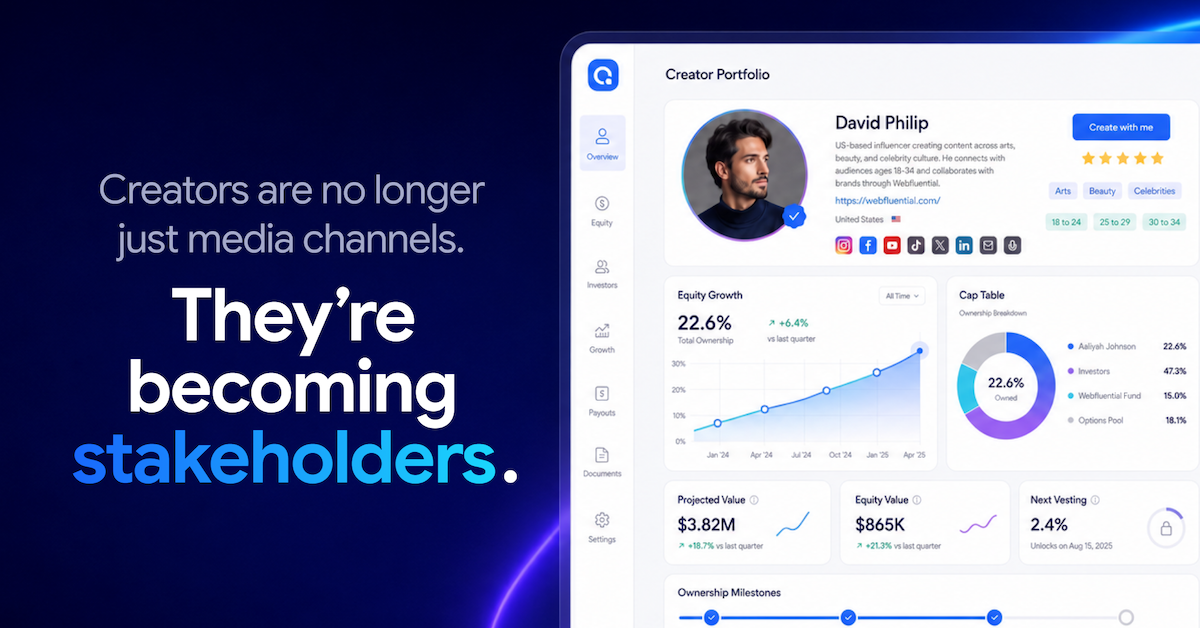
The creator economy is entering a new phase. Creators are no longer only being paid to post. They are becoming investors, advisors, operators and long-term stakeholders in the businesses they help grow.
The Forbes piece published this week about Cherub naming Nadya Okamoto its Chief Creator Officer landed with a quiet thud in most marketing circles. It probably shouldn't have.
For years, creators monetised through sponsorships, affiliate links and brand deals. Now a different model is taking shape: creators becoming angel investors, advisors, operators and strategic partners.
Okamoto's appointment is a useful symbol of that, but the more interesting story is what it signals for how brands should think about creator relationships going forward. The opportunity is especially significant in markets like Africa, the Middle East and South America, where creators are already becoming trusted media, distribution and commerce channels in their own right.
From social post to equity
Jaclyn Johnson, founder of Create & Cultivate and co-founder of Cherub, frames it as a three-era progression: the first was paid posts, the second was creators launching their own brands, and the third, where we are now, is creators saying they want ownership in the upside rather than another product launch.
That's not just a preference shift. It's a structural one.
When creators have equity, they're invested in the success of a business, not just in delivering a post. The paid partnership is transactional. Ownership creates alignment.
For brands, this changes the role of the creator from campaign partner to commercial stakeholder. It also changes the quality of advocacy. A creator who owns part of a business promotes it differently because their reputation, audience trust and commercial upside are tied to the outcome.
The clearest illustration of this model working at scale is Roger Federer's involvement with On Running. Federer didn't take a sponsorship fee. He took equity, reportedly around three percent of the company, and became a genuine product collaborator.
On went public on the New York Stock Exchange in 2021 at a valuation of around $7 billion. His stake was worth somewhere north of $300 million.
More importantly for the brand, Federer's involvement wasn't promotional noise. It was structural credibility. Every piece of coverage, every social post, every tournament appearance carried the weight of an owner, not a spokesperson. The difference in how audiences receive that is significant.
As Muna Ikedionwu puts it, treating influence as a form of capital helps quantify its impact on a business's bottom line. Social-first influence translates to more efficient distribution, audience trust and real-time first-party customer data. Federer's On story is that thesis in practice at the highest level.
MrBeast approaches it differently but arrives at a similar point.
He built one of the most powerful distribution engines in the history of media before he sold anything. Then, when he launched Feastables, his chocolate bar brand, he had north of 200 million subscribers across platforms who already trusted him.
The first Feastables launch reportedly sold out in minutes. His CPG products aren't backed by a legacy brand's media budget. They're backed by an audience that was built over a decade of compounding content investment.
Distribution first. Product second. The traditional FMCG model in reverse.
As Les Alfred notes, influencing for influencing's sake isn't sustainable. Promoting products builds other people's businesses more than your own. By becoming a founder, operator or investor, creators can take the influence they've built and turn it into something durable.
MrBeast took that logic to its logical extreme.
The emerging market opportunity
What's striking about the Western narrative around creator-investors is how much it assumes existing infrastructure: angel networks, accessible cap tables, platforms like Cherub or ShopMy that make deal flow visible to creators.
Ten years ago, people didn't know how to access that world. Now creators openly identify as angel investors in their bios. That normalisation happened fast in the US and Europe.
In Africa, the Middle East and South America, the equivalent shift is just beginning. The structural conditions are, in some ways, more compelling.
In Africa, mobile-first behaviour means creators aren't fighting legacy media for attention. They are the primary media.
A creator in Lagos or Nairobi with 500,000 engaged followers isn't competing with a newspaper. They're the paper.
Consumer trust in institutional media has eroded sharply across the continent while trust in peer recommendation and creator voices has grown. The creator who builds that audience and then takes equity in a fintech, an agri-tech platform or a health brand isn't just a marketing channel. They're a distribution moat.
The same logic applies in markets like Brazil, where social commerce is accelerating rapidly and where creators already function as genuine retail infrastructure.
Brazilian creators on TikTok and Instagram routinely drive single-day sell-outs for D2C brands. The leap from "I drove that sale" to "I should own part of that business" is a short one, and local founders are increasingly making it happen.
In the Gulf, the dynamic is different but equally interesting.
Creator culture there sits at the intersection of aspiration, community and commerce in ways that Western markets are still trying to engineer. Saudi and UAE-based creators have audience relationships that carry genuine authority, particularly in fashion, food, wellness and lifestyle.
As Vision 2030 diversifies the Saudi economy and local startup ecosystems deepen, the appetite for creator-investor partnerships is growing. The brands being built there need credible local voices, not imported celebrity endorsements.
For brands operating in these regions, the opportunity is not simply to buy creator reach. It is to build deeper partnerships with people who already understand local culture, community trust and purchase behaviour.
What this means for how brands should structure deals
Johnson is direct about the practical reality: most angel investing starts much smaller than people assume. You only need one winner.
For brands working in emerging markets, that means the equity conversation doesn't require a MrBeast-scale creator or a Federer-tier negotiation. A mid-tier creator with genuine community authority, offered a modest equity stake alongside a retainer, is a fundamentally different commercial relationship than a one-off post.
The real value is trust and conversion.
A creator with 150,000 highly engaged followers can be far more valuable than someone with millions of passive ones. In emerging markets, where community density matters more than raw reach, that principle is even more pronounced.
The conversation brands need to have is not "how much does a post cost?"
It's "what does it look like if we bring this person in as a stakeholder?"
The mechanics vary: equity, revenue share, options, co-creation rights or advisory roles. But the underlying logic is the same.
Creators who own something promote it differently. Their audiences can tell.
For marketing and brand teams, this also changes how success should be measured. The value of a creator partnership is not only impressions, reach or engagement. It is also distribution efficiency, community trust, conversion quality and the long-term commercial value of having an influential stakeholder aligned with the business.
The platform perspective
At Webfluential, we've watched this shift build for the better part of a decade.
The most effective brand-creator relationships we see aren't transactional. They're ones where the creator has genuine skin in the game, where their own reputation is tied to the brand's performance, not just to the delivery of a brief.
Ikedionwu puts it well: traditional media uses a top-down approach. Creators have flipped that dynamic. It's now a bottom-up system where audiences determine cultural relevance.
The creators who can translate their point of view into multiple proprietary verticals will win.
That's true globally. But in markets where traditional media infrastructure is thin, where consumer trust in institutions is low and where mobile-native audiences are growing fast, the creator who makes the shift from channel to stakeholder isn't just winning. They're building something that compounds.
Federer didn't just wear the shoes. He helped design them and owned a piece of the company that sold them.
MrBeast didn't launch a chocolate bar and hope for the best. He built 200 million people's worth of distribution first, then used it.
The playbook is there.
The question for brands, and for creators across Africa, the Middle East and South America, is how quickly they're willing to pick it up.
Are you ready? Let's chat
Join Webfluential and start growing your business
From micro enterprises to Fortune 500 companies, brands from over 130 countries have booked influencers on Webfluential.
Talk to our team