
February 13, 2026, 10:00
Is brand awareness dead? Why brand recall wins in the age of AI search

Murray Legg
 Add Webfluential as a preferred source
For decades, the great cathedral of modern commerce was built on a singular, unquestioned gospel: brand awareness. The logic was simple, seductive and ruthlessly effective. If a company could just put its logo in front of enough eyeballs - on highway billboards, between innings of baseball games, wedged into the glossy pages of magazines - the consumer would eventually capitulate. We worshipped at the altar of the impression. To be seen was to be sold.
But this gospel was written for a physical world that no longer exists.
We have drifted from physical shelves to an infinite horizon of digital search bars. And in this transition, the rules of human memory and corporate survival have been radically rewritten. Today, in an age defined by the psychic fragmentation of "brain rot," shrinking attention spans, and the omnipotence of artificial intelligence, passive awareness is essentially worthless.
If you want to survive the coming decade, you don't need consumers to know you exist. You need them to remember your name. You need brand recall.
The shift from awareness to recall is perhaps best understood through the soap aisle. In a recent analysis by Rex Woodbury, building on the trenchant insights of the tech strategist Ben Thompson, the dilemma of the modern behemoth is laid bare.
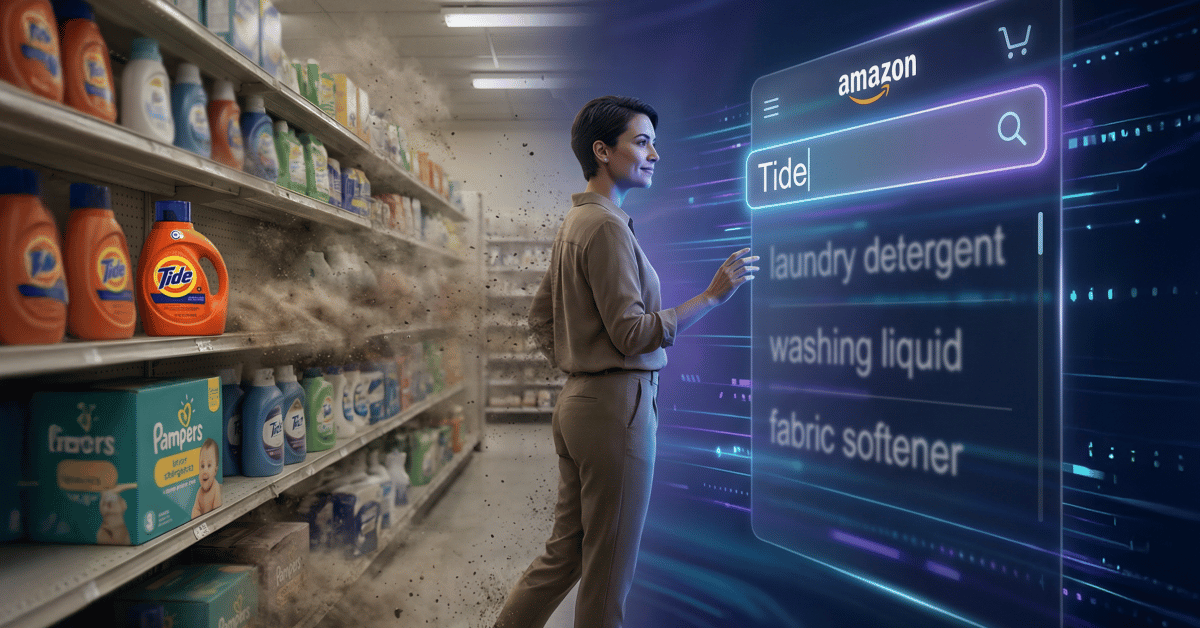
Consider Procter & Gamble. Before the internet colonised our shopping habits, P&G’s marketing mandate for Tide was remarkably simple: ensure that a customer, pushing a squeaking cart through a grocery store, would recognise the iconic orange bullseye on the shelf. That was it. Visual recognition was enough to trigger a purchase. As Woodbury noted, "Easy enough! Fun fact: Tide is P&G’s second-highest-selling brand, after Pampers diapers."
But the internet collapsed the physical aisle. Post-internet, P&G no longer needs the consumer to merely recognise the orange bottle; they need the consumer to proactively type the word “Tide” into a search bar. If a consumer simply types "laundry detergent" into Amazon, the algorithm takes over. Amazon might surface its own private-label products, or cheaper, digitally native competitors. In fact, despite Tide dominating the U.S. market with a 41 percent share - more than the next five brands combined - a generic search for "laundry detergent" on Amazon often leaves Tide buried as the ninth or tenth result.
Thompson correctly identifies this as the central tension of modern commerce. Because online search is initiated by the customer, you need them to proactively think of you. Moving a consumer from passive awareness to active recall is a significantly harder and more expensive proposition.
Yet, this is not just a problem for consumer packaged goods. It is an existential crisis across every sector, driven by a perfect storm of neurological overload and technological mediation.
We are living through what sociologists and cultural critics have dubbed "brain rot" - the slow erosion of sustained attention brought on by the deluge of the infinite scroll. We consume more information in a single afternoon than our ancestors did in a lifetime.
The human brain, desperate to conserve energy, has adapted by aggressively filtering out the noise. We are exposed to thousands of brands daily, but we remember almost none of them. As Byron Sharp, the influential marketing scientist and author of How Brands Grow, has long argued, the battle is for "mental availability." It is not about whether a consumer likes you; it is about whether they think of you at the precise moment a buying need arises.
This challenge is being accelerated by the sudden arrival of AI intermediaries.
As Google rolls out its AI Overviews, and platforms like ChatGPT and Perplexity become primary search engines, the intermediary layer between the consumer and the brand is thickening. AI is phenomenal at delivering value on broad, generic queries. If a user asks, "What is the best way to manage enterprise payroll?" an AI will synthesise a comprehensive, intelligent answer. But unless your brand has explicitly dominated the training data, the AI has no allegiance to you.
AI acts as a gatekeeper. If the customer searches for a generic category, the AI decides the winner. But if the customer searches for your brand name specifically - because they recalled it before they opened the app - you bypass the algorithm entirely. You leap over the moat.
Consider the brands that have successfully achieved this sort of cognitive monopoly.
Kleenex is the classic analog example; the brand name so completely colonised the category that the specific term replaced the generic. But look at the modern digital ecosystem. When you want to search, you “Google.” When someone needs a ride, they don't search "peer-to-peer transport apps" - they search Uber. When they want to stay in a stranger's house, they go directly to Airbnb. These companies do not rely on capturing generic search traffic. They are the destination.
So, how do marketers navigate this new reality? How does one become the default "category winner" in the mind of the consumer?
The framework requires a step back from mere tactics. We must look at the sociology of memory. Memory is triggered by emotion, distinctiveness, and repetition of a singular core truth. Here are some ideas to become more memorable (as a brand, of course):
- Own a singular mental concept. You cannot be all things to all people. To be recalled, you must be associated with a singular concept in the consumer's brain. Volvo equals safety. Coca-Cola equals happiness. If you do not define your one-word association, the internet’s chaotic algorithms will not do it for you.
- Move from "reach" to "resonance." Brain rot is real, so traditional advertising is easily ignored. Trust is transferred through human connection. Brands must partner with creators not just for product placement - the modern equivalent of the billboard - but to embed the brand into memorable, human narratives.
- Invest in distinctive brand assets. If visual recognition on a shelf is dead, you need assets that trigger a memory response across different mediums. Sonic branding (think of the Netflix "Ta-dum" or the HBO static), unique typography, and mascots are not novelties; they are the anchors that keep a brand from drifting into the abyss of forgotten content.
- Optimise for "branded search." Generic SEO is a race to the bottom, especially as AI subsumes the results page. The new metric of health is “Branded Search Volume”. Are people typing your name into the search bar? Content marketing must pivot from capturing traffic to creating a perspective so unique that users return specifically for your insights.
Cheap awareness is over. It was a comfortable illusion, sustained by mass media and physical proximity. Today, the marketplace is inside the consumer's head. The winners of the next decade will not be the brands with the biggest ad spend, but the ones that manage to carve out a permanent slice of real estate in the human memory.
Join Webfluential and start growing your business
From micro enterprises to Fortune 500 companies, brands from over 130 countries have booked influencers on Webfluential.
Talk to our team